

Fiji is strengthening its position as one of the Pacific region’s key telecommunications centres. Over the past year, telecom operators have continued investing in fibre infrastructure, expanding 5G coverage, improving international connectivity, and working with regional partners to improve communications across Pacific island nations. So, now let us see Can Fiji become the Pacific’s fibre and 5G connectivity hub along with Reliable LTE RF drive test tools in telecom & Cellular RF drive test equipment and Reliable Wireless Survey Software Tools & Wifi site survey software tools in detail.
Unlike many larger countries where networks primarily serve densely populated urban areas, Fiji must provide reliable connectivity across multiple islands separated by long stretches of ocean. This creates a different set of engineering challenges. Fibre backhaul, submarine cable capacity, radio access networks, microwave transport, and resilient international connectivity all need to work together to maintain service availability.
Recent investments show that operators are addressing these challenges through long-term infrastructure upgrades rather than focusing only on increasing mobile coverage.
Fibre Network Expansion Continues
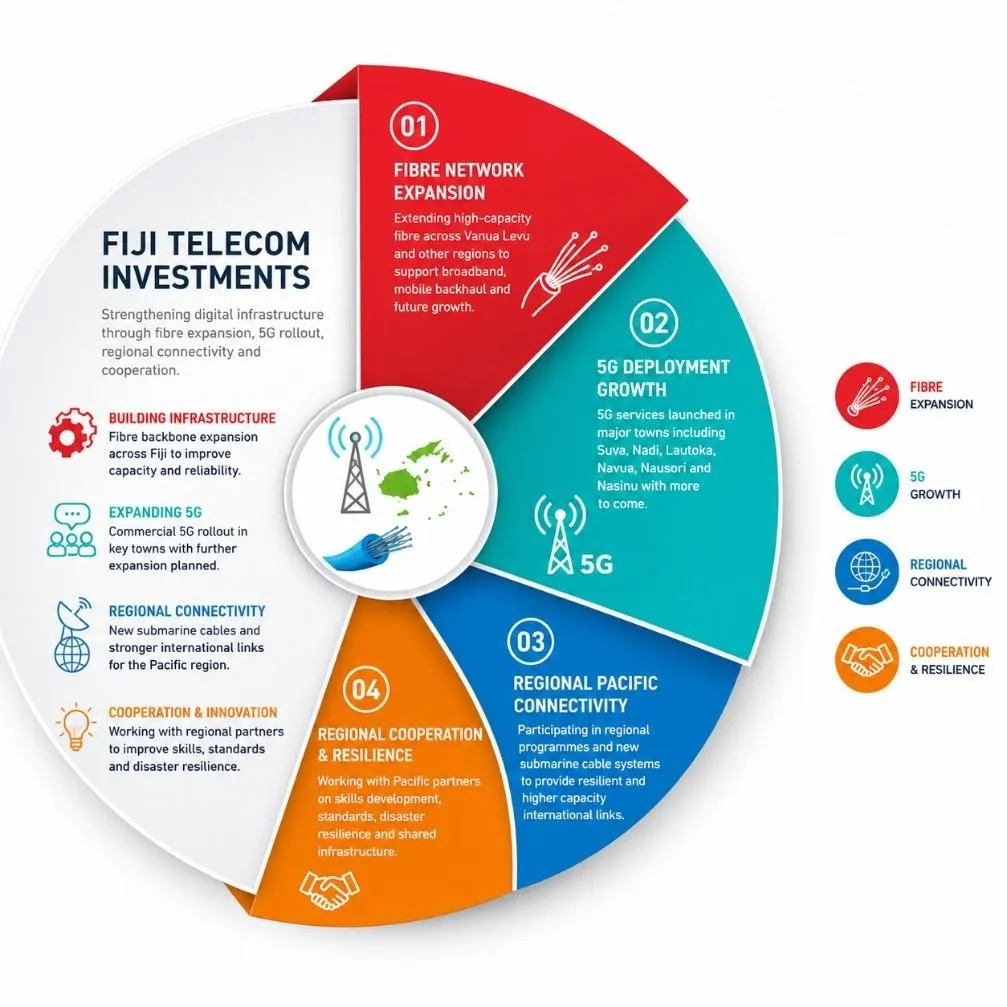
One of the largest infrastructure developments is Telecom Fiji’s multi-year fibre investment programme. This includes the recently completed Savusavu to Labasa fibre project, extending high-capacity connectivity across Vanua Levu and replacing older microwave-based transport for many services. The project improves backbone capacity while providing a more reliable transport network for residential, enterprise and government users.
Modern fibre infrastructure supports much more than broadband internet. It provides the transport network required for:
- Mobile backhaul
- Enterprise connectivity
- Government communications
- Data centre connectivity
- Cloud services
- Future 5G expansion
As mobile traffic continues to increase, fibre becomes the preferred transport medium because it offers higher bandwidth, lower latency and greater scalability than traditional microwave links.
5G Deployment is Expanding
Telecom Fiji officially launched its commercial 5G network in late 2025, with services initially covering Suva, Nadi, Lautoka, Denarau, Navua, Nausori and Nasinu. Additional expansion is planned as fibre infrastructure continues to grow across the country.
For operators, deploying 5G involves much more than installing new radio equipment.
Every new 5G site requires:
- High-capacity fibre backhaul
- Reliable power systems
- Low-latency transport
- Synchronised network timing
- Core network integration
Without sufficient transport capacity, additional radio spectrum cannot deliver its full performance. This is why fibre expansion and 5G deployment usually progress together.
Regional Connectivity Remains a Priority
Fiji is becoming an important connectivity point for the Pacific.
The country continues participating in regional telecom cooperation programmes that focus on submarine cable development, fibre infrastructure, internet exchange growth, technical collaboration and disaster resilience. Regional forums also allow operators, regulators and infrastructure providers to share operational experience and coordinate future connectivity projects.
Several new submarine cable systems are also increasing geographic diversity across the Pacific region. Fiji benefits directly from these developments because many neighbouring island nations depend on regional cable routes that pass through or connect with Fiji’s international infrastructure. Additional cable diversity reduces the effect of individual cable failures and improves international traffic resilience.
Network Performance Must Be Measured Continuously
Infrastructure investment is only one part of network improvement.
Operators also need continuous performance validation before and after network upgrades. Coverage maps alone cannot confirm whether users receive consistent service during busy periods or across different locations.
Routine field testing should include:
- 4G and 5G availability
- RSRP, RSRQ and SINR
- Downlink and uplink throughput
- Latency
- Packet loss
- Voice service performance
- Handover behaviour
- Indoor and outdoor coverage
Testing across cities, highways, ports, airports, business districts and tourist locations provides a clearer picture of actual network performance.
Smartphone-based RF drive testing platforms such as RantCell allow operators to automate measurements, compare multiple networks, monitor service quality remotely and generate standardised reports from a central cloud platform. This allows engineering teams to verify network improvements after fibre upgrades, radio optimisation or new 5G deployments.
Looking Ahead
Fiji’s telecommunications strategy continues moving towards stronger fibre infrastructure, wider 5G availability and better regional connectivity.
The combination of national fibre investment, commercial 5G rollout, submarine cable development and regional technical cooperation provides a solid foundation for future network growth. As more Pacific nations strengthen digital infrastructure, Fiji is well placed to support regional communications while continuing to improve network performance for businesses, government organisations and consumers.
The next stage will focus on maintaining service quality as traffic grows. This will require regular network testing, efficient backhaul management, resilient international connectivity and continuous monitoring across both fixed and mobile networks.
About RantCell
RantCell is a cloud-based mobile network testing solution that simplifies RF drive testing, indoor walk testing, private LTE/5G validation, CBRS testing, and network benchmarking. The platform provides real-time KPI collection, automated reporting, cloud analytics, and remote test management through Android smartphones. Operators and enterprises use RantCell to optimise network performance, improve user experience, and reduce the cost and complexity of large-scale network testing. Also read similar articles from here.